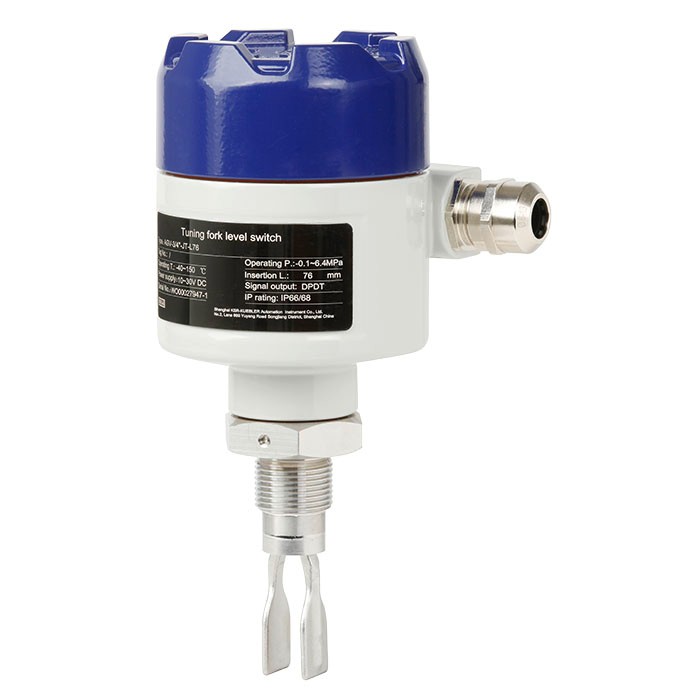
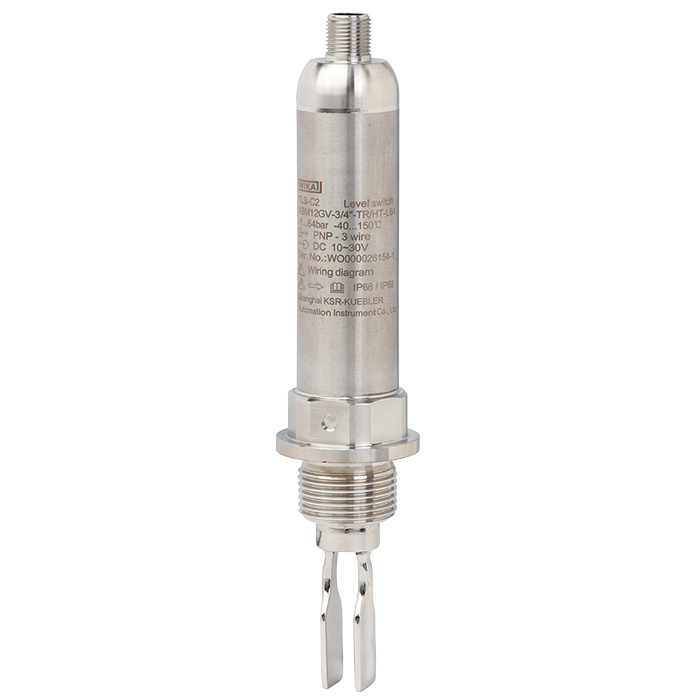
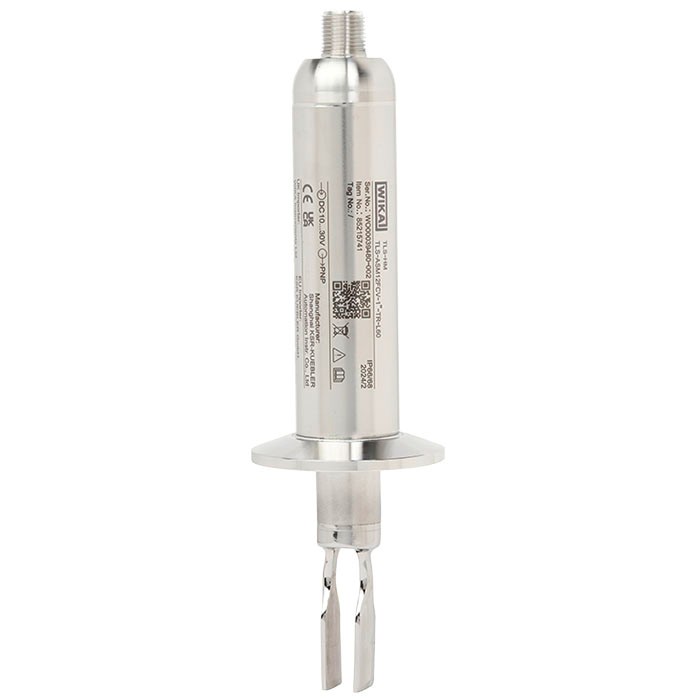
High accuracy in the detection of limit levels in variable mounting positions
The functionality of a vibrating level switch is based on a tuning fork that vibrates at its resonance frequency. When the fill level of the tank changes and the tuning fork is either covered or uncovered, the oscillation frequency changes. This change is analysed precisely, enabling reliable limit level detection. This is unaffected by the mounting position, pressure, temperature, foaming or viscosity of the liquid. This technology therefore offers a reliable way of detecting limit levels in a wide variety of container types and pipelines.
What is a vibrating level switch?
A vibrating level switch is a limit level switch for monitoring fill levels. It is used in many industries to detect the presence of liquids or solids in a container.
How does a vibration limit switch work?
The core element of the vibrating level switch is the so-called tuning fork with integrated vibration drive. When the vibrating tuning fork is immersed in the medium, the resonance frequency of the tuning fork decreases. The frequency change is detected by the electronic circuit and is converted to a switching signal.
In which applications are vibrating level switches used?
In general, vibrating level switches are used for two very important functions: On the one hand, the vibrating level switches are used as an overflow control to prevent containers from overflowing when reaching a certain limit level. On the other hand, vibrating level switches are used as a dry run protection so that, for example, pumps switch off in time if there is not enough medium in the intake pipe. The vibrating level switch can detect when a pump runs dry and thereby prevent damage to the pump.
What are the advantages of vibrating level switches over traditional float switches?
In contrast to traditional float switches, vibrating level switches offer a very compact design, which is especially suited for monitoring limit levels in pipeline systems. Another benefit is that they are independent from the mounting position, making the vibrating level switch versatile.
There are also vibrating level switches for solids, such as granules or powders. Float switches, by contrast, can only be used to detect liquid media.
What benefits do vibrating level switches offer in the industrial sector?
The robust design and easy installation make vibrating level switches a popular choice for many industrial applications. Their ability to work precisely under various conditions makes them an essential tool in modern process control and automation.



 Can't find the right solution?We'll engineer it for you →